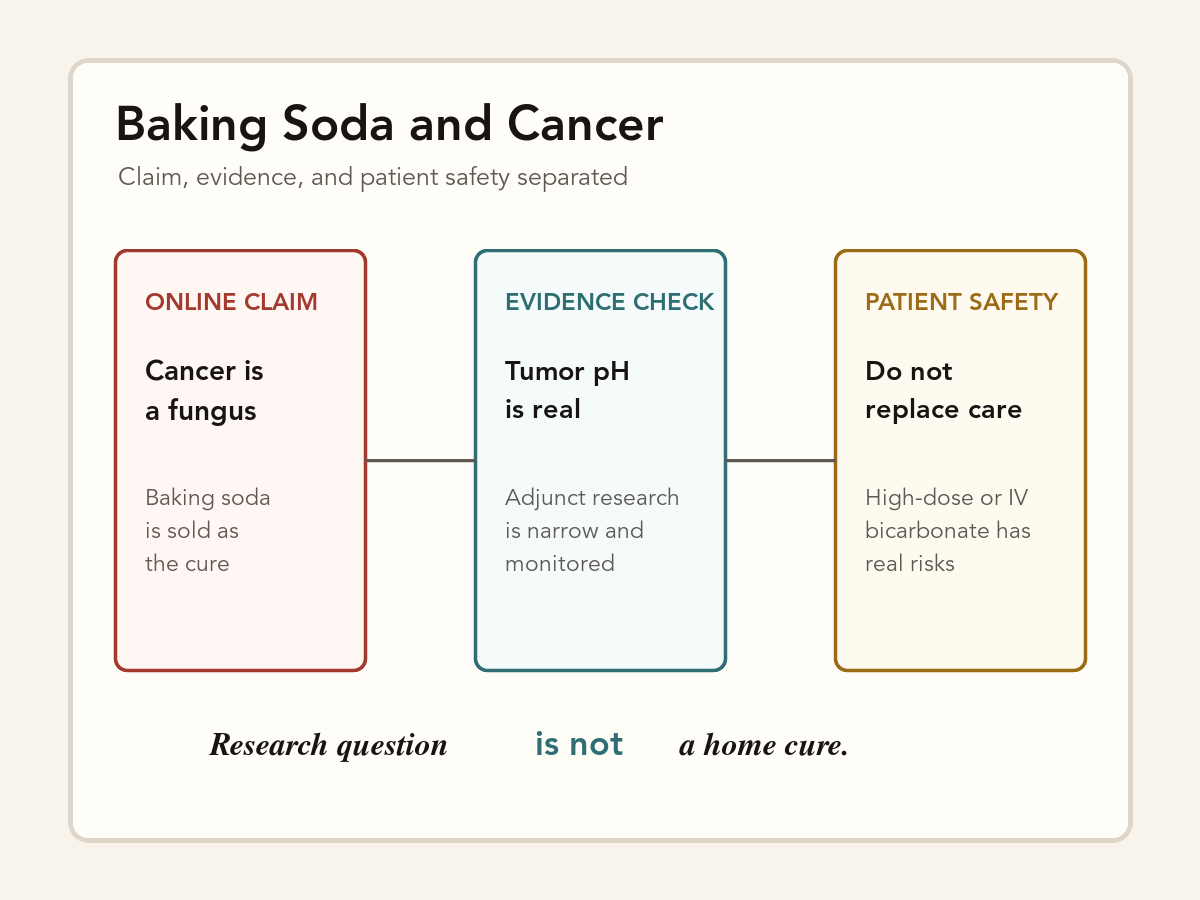
Baking soda does not cure cancer. The Simoncini sodium-bicarbonate story is not a treatment protocol: it is a claim that cancer is a fungus and household bicarbonate is the cure. Tumor acidity is real research. Bicarbonate has been studied as an adjunct in models. None of that authorizes replacing oncology care. Walk the six findings on The Verdict.
The useful question is not whether bicarbonate changes acidity in a lab. It is whether a cancer patient should use it as treatment. Those are different questions.
Signature desk
The Verdict
Six counts. Each one is folklore, theory, or evidence. Stamp the finding. The desk does not dose, treat, or replace an oncologist.
Each count is labeled folklore, theory, or evidence. The stamps are editorial findings, not a calculator and not medical advice.
Count 1 of 6 is open. Enter the finding to stamp it. Baking soda does not cure cancer.
folklore · A household-chemical cure story, not a clinical finding.
Does baking soda cure cancer?
Circulating wording: Baking soda cures cancer.
Rejected
There is no good clinical evidence that baking soda treats or cures cancer. Cancer Research UK addresses this myth directly and finds no evidence that sodium bicarbonate is a cancer cure.
A real buffer and a real word, acidity, are being asked to do work they have not earned in patients.
This finding is not a recipe, a dose, or a substitute for oncology care.
Three statements can all be true at once. Keeping them separate prevents the misinformation jump.
No, baking soda is not a cancer cure.
Cancer Research UK directly rejects the fungus-and-bicarbonate theory, and NCI describes cancer as uncontrolled growth of abnormal human cells, not fungal overgrowth.
Yes, tumor acidity is a real research area.
The Warburg effect, extracellular acidity, and pH-sensitive imaging or adjunct therapies are legitimate cancer-biology topics.
Replacing care can be dangerous.
NCI has reported worse survival when patients use alternative medicine instead of conventional initial cancer treatment.
Read by question
Each page handles one part of the claim, with sources and internal links for context.